Περίληψη
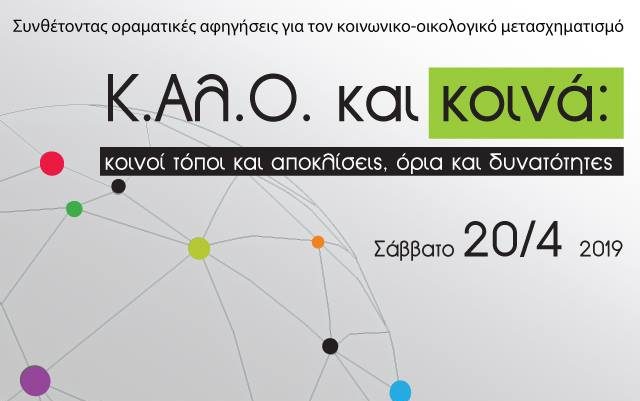
The first composition, the workshop "Social and Solidarity Economy and the commons: common places and deviations, limits and possibilities "(Saturday, April 20, 2019), will attempt to bring together academics, researchers, activists, cooperatives and civil society in fruitful dialogue. The main objective of the workshop is to present and broaden the theoretical framework through an interdisciplinary approach. Highlight good practices and paradigms. Discuss concerns and antinomies on key issues. Analyse the relationship of both Social and Solidarity Economy (S.S.E.) and the commons with direct and representative democracy respectively. And finally, disseminate those visionary narratives which, among others, could liberate the potentialities for justice and freedom and create new opportunities and ideas towards socio-ecological transformation.
In a primary level Sofia Adam* (S.S.E.- Hellenic Open University- HBS), Alexandros Kioupkiolis (Commons- Department of Political Science, A.U.TH.) and Vassilis Kostakis (Digital Commons- P2P Lab, Cosmolocalism) will attempt to answer to the following questions with a speech.
- Which approaches of SSE/ commons have a clear targeting towards socio-ecological transformation?
- Are SSE/ commons non-capitalistic? Where do we identify the differences?
- How can peer production be emancipated from commodity production?
- Is the involvement in commons a political act in itself?
- How do projects concerning SSE/ peer-production/ the commons process gender issues and more precisely gender equality?
- Are digital commons and peer production linked to SSE only through open co-operation? Are there other ways to interconnect?
- Is the commons paradigm intertwined with the local scale?
- What is the relationship of SSE/ peer-production/ the commons with direct democracy and what is its relationship with representative democracy?
- Are there examples of public policies that protect or develop SSE/ the commons? In which countries? On what scale (local government, central government)? Through which process did they emerge? What challenges do they face?
The first two contributions (key note speakers- S. Adam, V. Kostakis) will form the basis for opening the discussion in order to focus more properly on cutting-edge issues and foster the emergence of new questions.
Discussion groups will then be set up (designate coordinator and rapporteur) and work parallel in order to deliver a ten-minute presentation. After the afternoon contribution (key note speaker- A. Kioupikolis), the debate will be opened in plenary session, putting forward reflections and proposals. The workshop will be completed by presenting / summarizing the central conclusions.
All plenary boards will be formed with the participation of both sexes.
The workshop is aimed at a total of about 40 people (gender equality). The main target is to address people participating in SSE, the city's movements (commoners), civil society and academia. Ideally, these people should have a genuine interest in the subject, as they will be invited to attend and contribute, with their interventions and suggestions, in an all-day workshop.